
When a tenant reports mold or a musty smell, log it, acknowledge it in writing the same day, inspect the HVAC, and treat the source fast. Whole-home disinfection for mold is $0.30 per heated square foot per unit ($200 minimum). Vents are $50 each on the same visit, or from $399 alone. There is no tear-out, and a 12-month written guarantee goes in the unit file.
See your price
- Whole-home disinfection: $0.30 per heated sq ft ($200 minimum)
- Clean the vents on the same visit: $50 each (no extra minimum)
- Both include Bactronizing with BactroKill Plus + 12-month written guarantee
Not sure what you need?
Start with the vents
A smell that rides the air is growing in the duct work. We scrub each vent and return with a rotary brush, clean the registers, the coil and the outside of the air handler, then treat them. $50 a vent, from $399 on its own. Spores travel on the air, so most people add the whole-home disinfection on the same visit, and then the vents carry no minimum. 12-month written guarantee.
Start with the whole home
A smell that sits in the rooms, or came with the last people, is on the surfaces, not only in the air. Whole-home disinfection sprays every surface in the house, closets included, plus the duct work and the drain pan: $0.30 per heated square foot, $200 minimum, about 30 to 75 minutes, and you can stay home. Dust or growth in the vents needs cleaning first, so add the air duct cleaning at $50 each on the same visit if the vents are dirty. 12-month written guarantee.
We look first
Mold you can see gets wiped off, not sprayed over. Every one is different, so we look before we price it, and Greg puts the price in writing before any work starts.
Fix the water first
Mold is a water problem first. Wet material grows again, so the leak, the flood or the drain line gets fixed before anything is sprayed. Once it is dry we treat it, and if something is still wet we say so before we start.
Two ways to be sure
If you can smell it or see it, the CDC says you do not need to know the type, so most people skip the test and treat. To be sure anyway: while we are at the house we can swab a surface and read it on a hand-held meter, or send samples to a lab, $350 for two and $450 for four.
Request a window Or start with the treatment Call 843-282-7777
Open now. Closes at 4 pm.
Call 843-282-7777Request a windowGreg confirms it in writing.Do not know the square footage? Request a visit without a number. We work it out when we come out.
Veteran owned. Licensed and insured. EPA-registered product. 12-month written guarantee.
Is the landlord or the tenant responsible for mold from the HVAC?
In general, the tenant handles what they control day to day, like changing the filter, and the owner or manager maintains the unit and its ventilation system. HVAC and ductwork are building systems, so duct mold usually lands on the landlord side. Lease terms and the facts of each case vary, so this is general guidance, not legal advice.
The cleaner way to think about it: a clogged filter a tenant ignored is a tenant conversation, but mold growing on the coil or in the ducts is a building-maintenance issue. Most habitability frameworks expect the owner to keep the dwelling and its systems in livable condition. When in doubt on a specific lease or claim, run it past your attorney.
What should I do the moment a tenant reports mold or a musty smell?
Treat the report as a documented maintenance request from minute one. A fast, recorded response is your best protection, because liability questions tend to turn on whether you knew and failed to act.
- Log the report with date, unit, and the tenant’s exact words. A musty smell counts as notice.
- Acknowledge in writing to the tenant the same day, so the timeline shows you acted.
- Inspect the HVAC and ducts, not just the visible vent cover. The smell usually starts deeper in, on the coil or in the duct run.
- Find the moisture source. The EPA is blunt about this: “The key to mold control is moisture control” (EPA, A Brief Guide to Mold, Moisture and Your Home).
- Treat and document the unit, then keep the guarantee paperwork in the unit file.
Speed matters for a physical reason too. After water gets into a system, mold can begin growing within 24 to 48 hours (EPA, Flood Cleanup to Protect Indoor Air and Your Health). A report sitting in an inbox is a problem getting worse.
How does unaddressed mold become a liability problem?
The risk is rarely the mold itself on day one. It is the gap between when you were told and when you acted. Across most landlord-tenant frameworks, exposure grows when an owner knew about a habitability issue and failed to address it in a reasonable time. A documented, prompt response closes that gap.
Unaddressed reports can escalate into habitability disputes, rent-withholding claims, or move-out and re-leasing costs that dwarf the price of a treatment. We are not your lawyers, and SC-specific rules and your lease govern the actual duty. What we can do is make the “we acted promptly” half of the record easy: a dated treatment, a 12-month guarantee on file, and a system you can show was handled.
How do I budget a unit before anyone walks in?
By the one number you already hold. Whole-home disinfection is $0.30 for every heated square foot of the unit, the same rate in a one-bedroom and a townhome, with a $200 minimum. The heated square feet of every unit in your portfolio is already on the rent roll and the county tax card, so you can price a whole building from your desk without sending anyone to count anything.
Air duct cleaning and treatment is the add-on, done on the same visit: the registers, the duct work, the coil and the outside of the air handler. Its prices are in the table below. None of them move at the door.
That is the difference for a portfolio. Conventional HVAC-system mold removal is priced at $2,000 to $10,000 nationally (HomeGuide 2026; This Old House 2026, national estimate, Charleston SC area). A treatment caught early keeps a routine unit turn from becoming that kind of line on your operating statement.
Per-unit HVAC mold treatment pricing for managed properties
| Scope | Price | What it is |
|---|---|---|
| Whole-home disinfection, per unit | $0.30 per heated square foot, $200 minimum | The unit room by room with an electrostatic sprayer. Closets in, garage in when its footage is in the number. Our price, on this page. |
| HVAC vents, on the same visit | $50 a vent, however many you have | The registers, the duct work, the coil and the outside of the air handler. A vent is any register in the unit, supply or return. |
| HVAC vents, booked on their own | $50 a vent, starting at $399 | The same air-system work when the vents are the only job on the work order. |
| Dryer vent, added to the same visit | $50 | Optional per unit. $99 when it is booked on its own. |
| Conventional HVAC-system mold removal | $2,000 to $10,000 | What an untreated problem can become. National estimate, Charleston SC area (HomeGuide 2026, This Old House 2026). |
See your price. It asks for the unit’s heated square feet and the vent count if you want the air system done too.
Can you treat units fast between tenants, turn-ready?
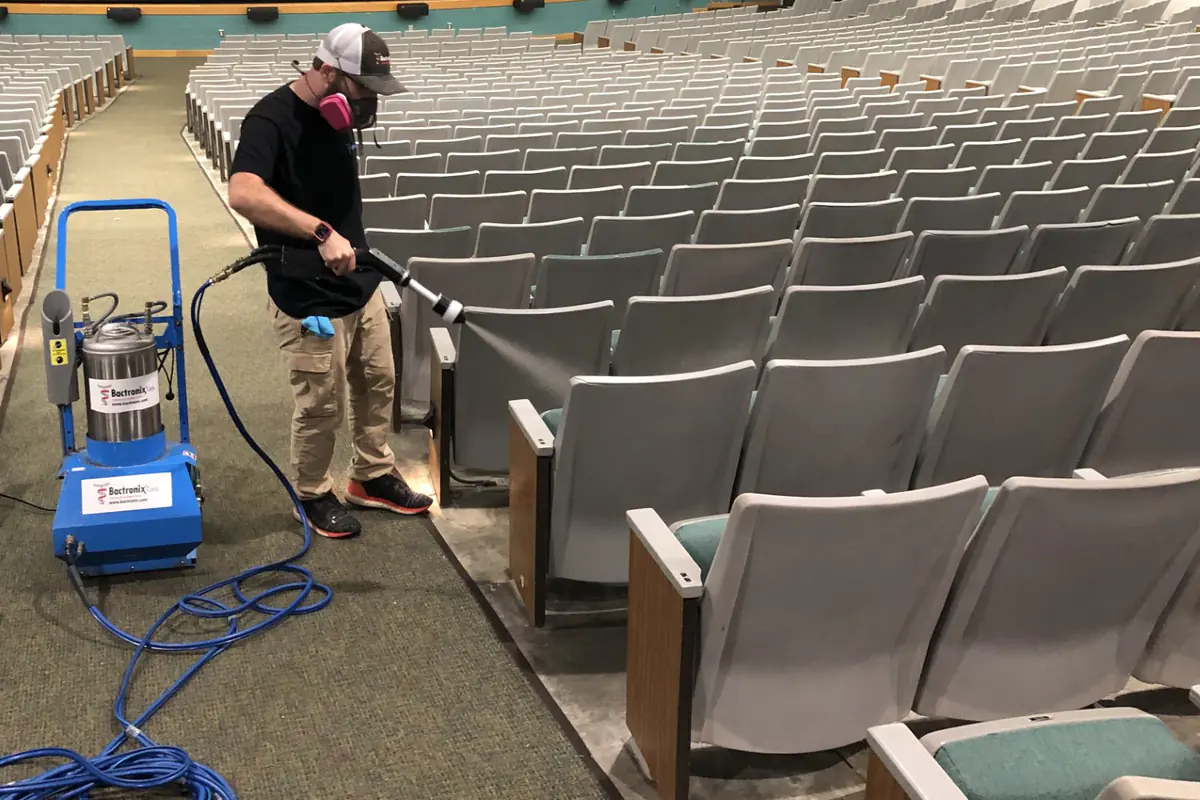
Yes, and the no-tear-out method is the reason. We clean and treat the existing unit and duct system in place, so there is no drywall to open and no containment to build.
Time at the unit: about 30 minutes to treat a 1,500 square foot unit, about 45 at 2,500, about 75 at 3,500. Vents add about 90 minutes at 12 and about two hours at 15. A tenant can stay in the unit. People and pets keep out of a room while we spray it, and the room is back in use 15 minutes later, so an occupied unit does not have to be emptied to get it done. No trip charge. You pay on the day.
Scheduling a building is a separate conversation. Call 843-282-7777 with the address and the unit count, and we will tell you what we can cover and when.
What documentation do I get to show the tenant the system was treated?
You get a dated record of the treatment per unit and the 12-month guarantee in writing, which is exactly the paper you want in the unit file and in front of a concerned tenant. It shows the date you acted, that the unit was treated with BactroKill Plus, an EPA-registered product (EPA Reg. No. 82972-1-90746), and that the work is backed for a year.
That record does two jobs. It reassures the tenant that the building system was handled, and it builds the “we responded promptly” timeline that matters if a report ever becomes a dispute. Keep it with your maintenance log for that unit.
How does the 12-month guarantee protect a managed portfolio?
If treated mold returns inside 12 months, we come back and re-treat that unit at no charge. For a manager, that converts an unpredictable callback risk into a known, covered line item. One tenant complaint per unit per year does not turn into a fresh invoice.
It works because of the order. The EPA cautions against applying a biocide in a system nobody cleaned first (EPA, Should You Have the Air Ducts in Your Home Cleaned?). We find the moisture feeding the mold, clean the system, then apply the product to its label.
This is treatment. It is not structural mold remediation, and it does not fix an active leak. Moisture that is still wet can grow mold again, so if we find water coming in, you hear it from us before we spray, and the leak goes to your maintenance vendor first.
Can you set up recurring treatment across multiple properties?
Yes. We schedule multi-unit and recurring work directly with the manager, so you have one vendor, one price list, and one point of contact across the portfolio. Bundle a building, stagger units across a turn season, or set a recurring cadence for properties that run humid.
One owner sets those prices: Greg Busang, a veteran who owns the company. No account is too small to start and no portfolio gets a different price.
Where we work
We cover the Lowcountry rental footprint: Cane Bay, Nexton, Carnes Crossroads, Summerville, Goose Creek, and Moncks Corner. The two linked pages cover the local build context behind tenant mold reports there, at the same prices.
For the full treatment scope and the guarantee, see whole-home disinfection. The air-system job in full is on air duct cleaning and treatment.
Frequently asked questions
Is the landlord or the tenant responsible for mold from the HVAC?
In general, the tenant handles what they control day to day, like changing the filter, and the owner or manager maintains the unit and its ventilation system. HVAC and ductwork are building systems, so duct mold usually lands on the landlord side. Lease terms and the facts of each case vary, so this is general guidance, not legal advice.
What should I do the moment a tenant reports mold or a musty smell?
Treat it as a documented maintenance request from minute one. Log the report with the date and the tenant’s exact words, acknowledge it in writing the same day, inspect the HVAC and ducts rather than just the vent cover, find the moisture source, then treat and document the unit. A fast, recorded response is your best protection, because liability tends to turn on whether you knew and failed to act.
How do I budget a unit before anyone walks in?
By the heated square feet, which is already on your rent roll and the county tax card. Whole-home disinfection for mold is $0.30 per heated square foot, with a $200 minimum per unit. Air duct cleaning and treatment is $50 a vent on the same visit, however many you have, with no extra minimum. On its own, air duct cleaning and treatment starts at $399. The prices never move at the door.
Can you treat units fast between tenants, turn-ready?
Yes. We clean and treat the unit and its duct system in place, so there is no drywall to open and no containment to build. Time at the unit: about 30 minutes for a 1,500 square foot unit, about 75 at 3,500, and about 90 minutes for 12 vents. A tenant can stay in the unit. People and pets keep out of a room while we spray it, and the room is back in use 15 minutes later, so an occupied unit does not have to be emptied.
What documentation do I get to show the tenant the system was treated?
You get a dated record of the treatment per unit and the 12-month guarantee in writing. It shows the date you acted, that the unit was treated with an EPA-registered product, and that the work is backed for a year. That record reassures the tenant and builds the “we responded promptly” timeline that matters if a report ever becomes a dispute.
Can you set up recurring treatment across multiple properties?
Yes. We schedule multi-unit and recurring work directly with the manager, so you have one vendor, one price list, and one point of contact across the portfolio. Bundle a building, stagger units across a turn season, or set a recurring cadence for humid properties.
Request a window
Put the unit’s heated square feet in above, and the vent count too if the air system needs doing. Pick the day and window that suit you, and we call or write back to lock in the time.