
Start by finding out whether the smell rides the air system or lives in one room. Change the filter, check the AC drain line, look for damp under the sinks and under the house, then smell a supply register as the system starts. Fix any water first. Treatment comes after.
See your price
- Whole-home treatment: $0.30 per heated sq ft ($200 minimum)
- Treat the vents on the same visit: $50 each (no extra minimum)
- Includes Bactronizing with BactroKill Plus + 12-month written guarantee
Open now. Closes at 4 pm.
Call 843-282-7777Request a windowGreg confirms it in writing.Do not know the square footage? Request a visit without a number. We work it out when we come out.
Veteran owned. Licensed and insured. EPA-registered product. 12-month written guarantee.
What should you check in the first week?
Five things, in order: the filter, the air handler and its drain line, the damp spots, the register test, and the dryer vent. By the end you will know whether you have a water problem, an air system problem or a lived-in house.
1. Change the filter. ENERGY STAR says to inspect, clean or change it once a month (source).
2. Find the air handler and look at its drain line. Check the closet or attic around it for standing water, rust, or a stain on the ceiling below. The EPA’s advice: “Keep air conditioning drip pans clean and the drain lines unobstructed and flowing properly” (source). A stopped line is an HVAC company’s fix.
3. Look for damp. Open every sink cabinet. Check around tubs, toilets, the water heater and the washer lines. In a crawlspace, look for standing water and bare dirt: NC State Extension’s checklist calls for a plastic vapor barrier over the soil (source). On a slab, check the baseboards along the outside walls.
4. Run the register test. Leave the system off for an hour, stand at a supply register, and turn it on. A smell that arrives with the first air and then fades points at the air system, as explained on why your AC smells musty. A smell that stays in one room, or shows up after rain, has its source there. Dark specks at the vents? See black dust around air vents.
5. Check the dryer vent. NC State’s checklist says to make sure the outside dryer vent “is not blocked or filled with debris” and that it vents outdoors (source). A dryer dumping damp air indoors adds to it: see dryer vent cleaning.
What do previous owners leave behind in a house?
Years of ordinary living. Smoke, pets and cooking settle into the dust, the soft surfaces and the air system, and a house that sat closed up between owners adds a damp note. Buyers tend to describe it the same way: a stale, lived-in smell they cannot place.
That is the smell a whole-home treatment is for. The product takes out musty, smoke and cooking odors by oxidizing them rather than covering them. It has to touch what the smell is coming off, so the job goes room by room, closets included. Pet odor soaked into carpet pad or subfloor is a flooring job.
The EPA says you may suspect hidden mold “if a building smells moldy, but you cannot see the source” (source). The CL-100 letter from your closing does not settle it. It reports wood-destroying organisms and excessive moisture under the house (source). It does not test for mold or grade the air system: see the CL-100 and duct mold.
When is it a moisture problem that has to be fixed first?
When something is still wet. A drain line that has stopped draining, a slow leak under a sink, standing water under the house, or a stain that grows after rain is a job for a plumber, a roofer or an HVAC company first. Treat over live water and the smell comes back.
The EPA’s line: “The key to mold control is moisture control” (source). NC State’s checklist: “First, find the source of the moisture and then fix the problem” (source).
This is treatment. It is not structural mold remediation, and it does not fix an active leak. Moisture that is still wet can grow mold again, and carpet pad, drywall or insulation that soaked through gets replaced, not treated. Flooded? See mold in air ducts after water damage.
Where does a whole-home treatment fit, and what does it cost?
It fits after the water is fixed, and before the furniture is in if you can time it. Whole-home mold treatment is $0.30 per heated square foot with a $200 minimum, and it covers every room, closets included. If the register test points at the air system, HVAC vent treatment is $50 a vent on the same visit with no extra minimum, or from $399 booked alone. Every job carries a 12-month written guarantee.
Dryer vent cleaning is $50 added to the visit, or $99 alone. The guarantee goes on the invoice: if what we treated comes back inside the year, we re-treat it, except where new water has come in. No trip charge. You pay on the day. It takes about 30 minutes at 1,500 square feet, 45 at 2,500 and 75 at 3,500. You can stay in the house. Keep people and pets out of a room while it is sprayed. It is yours again 15 minutes later.
The product is BactroKill Plus, EPA Reg. No. 82972-1-90746, applied to its label by electrostatic sprayer. Bactronix calls that Bactronizing. On the vents we clean, then treat, the registers, the duct work, the coil and the outside of the air handler.
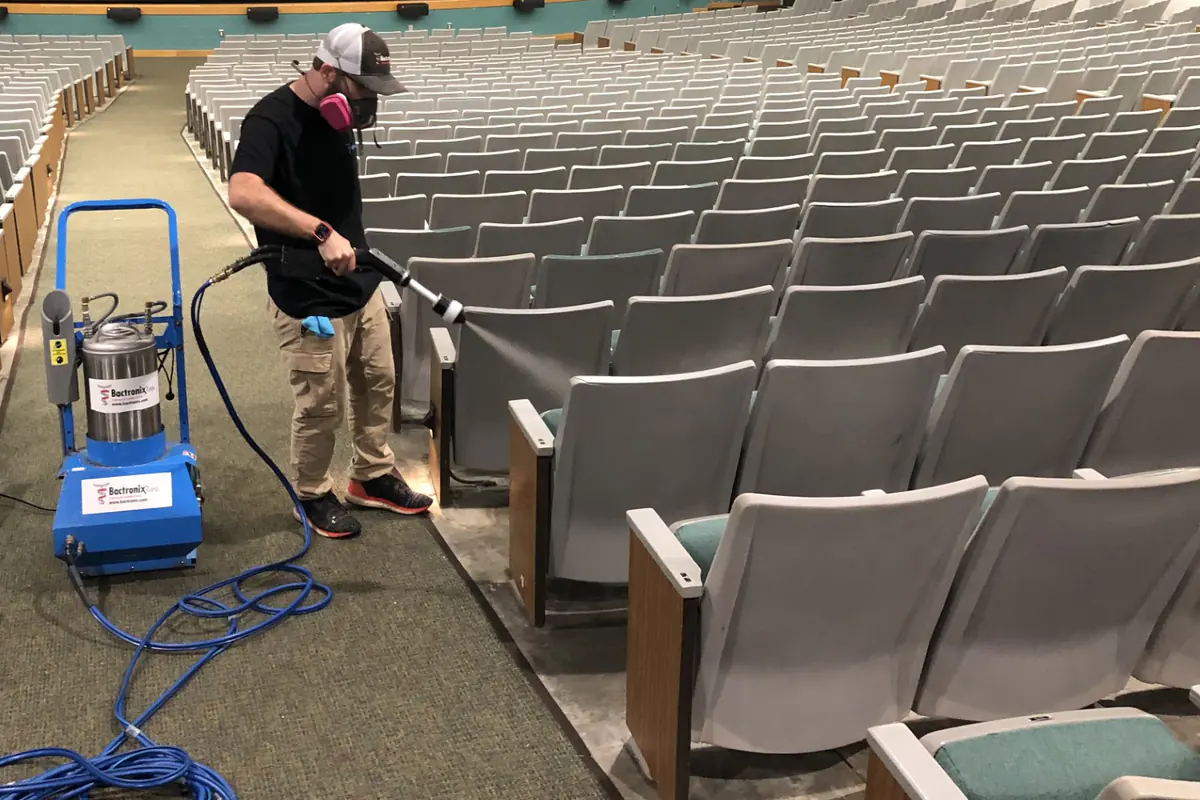
Your heated square feet is on the listing. We work in Charleston, Summerville, Cane Bay, Nexton, Carnes Crossroads, Goose Creek and Moncks Corner.
Frequently asked questions
Will the smell from the previous owners fade on its own?
Stale air does. A smell with a source stays, because the source is still there: a wet coil, smoke film in the dust, a damp cabinet floor.
Should I have the ducts cleaned before I move in?
Only if something has been found: debris, visible growth, or renovation dust in the returns. Air duct cleaning removes dust, and it does not replace treatment.
Is it better to treat before or after we move in?
Before is easier: the rooms are empty and every closet is open. After works too, and you do not have to leave the house.
Request a window
Put your square footage into the price calculator above and the price comes back. Pick the day and window that suit you. We call or write back to lock in the time.